
Geometry And Collisions
For both Throw a Watermelon and Trick Shot II, I wrote my own collision methods to determine closest points to shapes, collisions, overlaps etc. For trick-shot which can run on a microcontroller, it was especially important that the alogorithms were efficient and ran with deterministic complexity.
I’m documenting the selected algorithms here.
Lines
Line Intersection
I found documentation from Bryce Boe here bryceboe.com - line segment intersection algorithm.
Given we have two lines AB and CD, we look at the direction of all four sets of three points. This works because the directions change as the lines intersect.
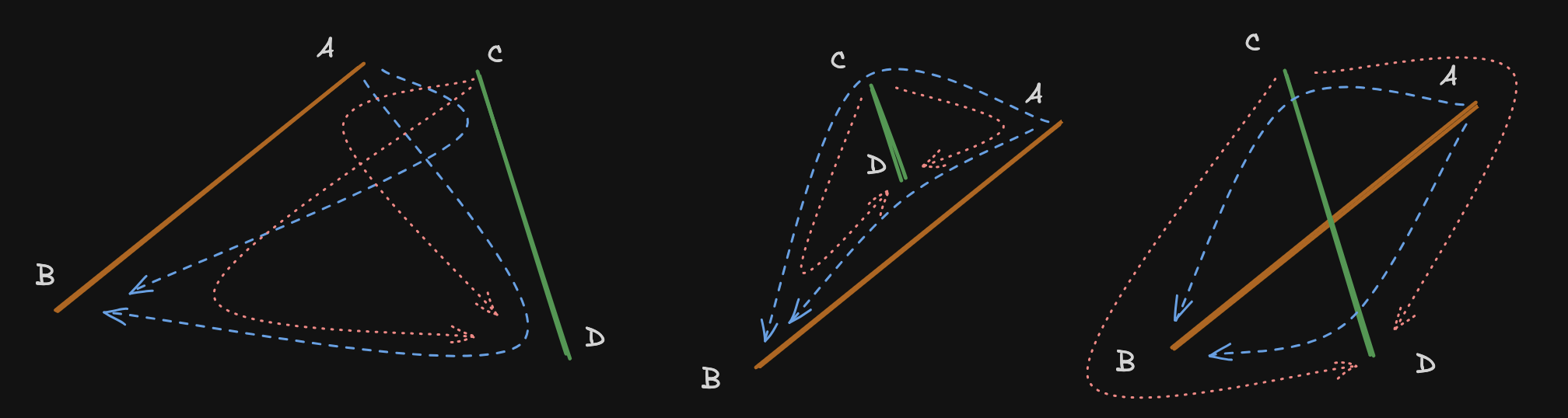
We take three points, say A, B from the first line and C from the second. We calculate whether the points are arranged in a clockwise or counter clockwise direction. We then switch point C with D and then determine if points A, B, D are clockwise or counter clockwise. If both checks have the same direction, then the line segments do not cross.
We then do the same check for points C, D, A and C, D, B - this prevents a false positive where one line points into the other, but doesn’t intersect with it.
To determine orientation:
\[ccw_{abc} = (C_y-A_y)(B_x-A_x) \gt (B_y-A_y)(C_x-A_x)\]Then to determine if lines intersect:
\[intersect_{AB-CD} = \left(ccw_{abc} \neq ccw_{abd}\right) \&\& \left(ccw_{cda} \neq ccw_{cdb}\right)\]Closest Point On Line
If we have line AB and a point P, we want to find Q - a point on AB that is closest to P.
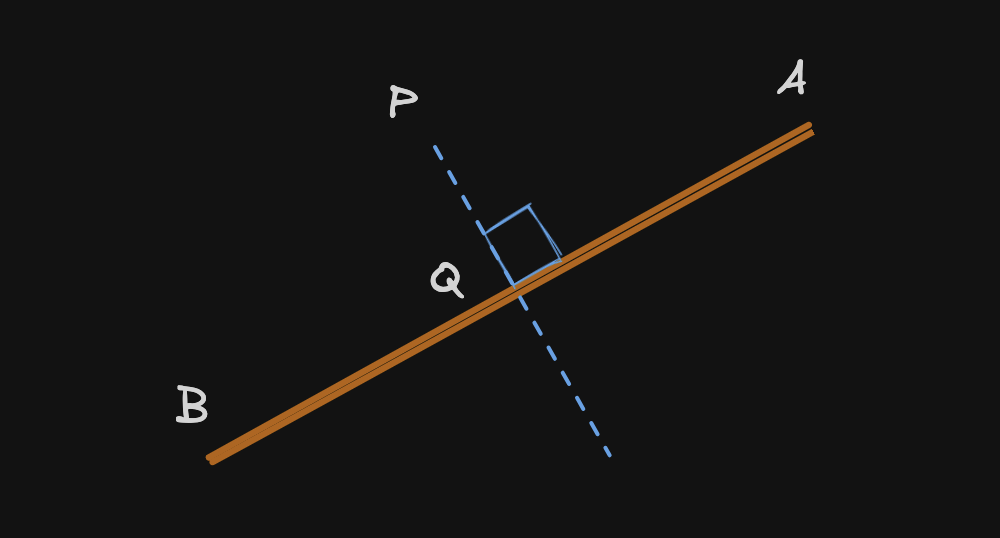
This is achieved by finding \(P_{\infty}\) the projected point which would lie on AB, if AB were an infinite line. If \(P_{\infty}\) is inside AB, then \(Q=P_{\infty}\) otherwise we clamp it to the closest end.
\[\begin{align} u_{AB} &= \frac{B - A}{||B - A||} \\ d &= (P - A) \cdot u_{AB} \\ p_{\infty} &= A + u_{AB} d \\ Q &= \operatorname{clamp}(p_{\infty}, A, B) \end{align}\]Where:
- \(u_{AB}\) is the unit vector of the line \(AB\)
- \(d\) is the distance that the projected \(P\) lies across the line \(AB\)
Polygons
Polygon algorithms generalize a bunch of different shapes, I used these to handle triangles and rectangles. The algorithms here also don’t care if the polygon is convex or concave, which is quite handy.
Point in Polygon
geeksforgeeks.org provided an excellent algorithm for determining if a point is in a polygon.
The general idea is:
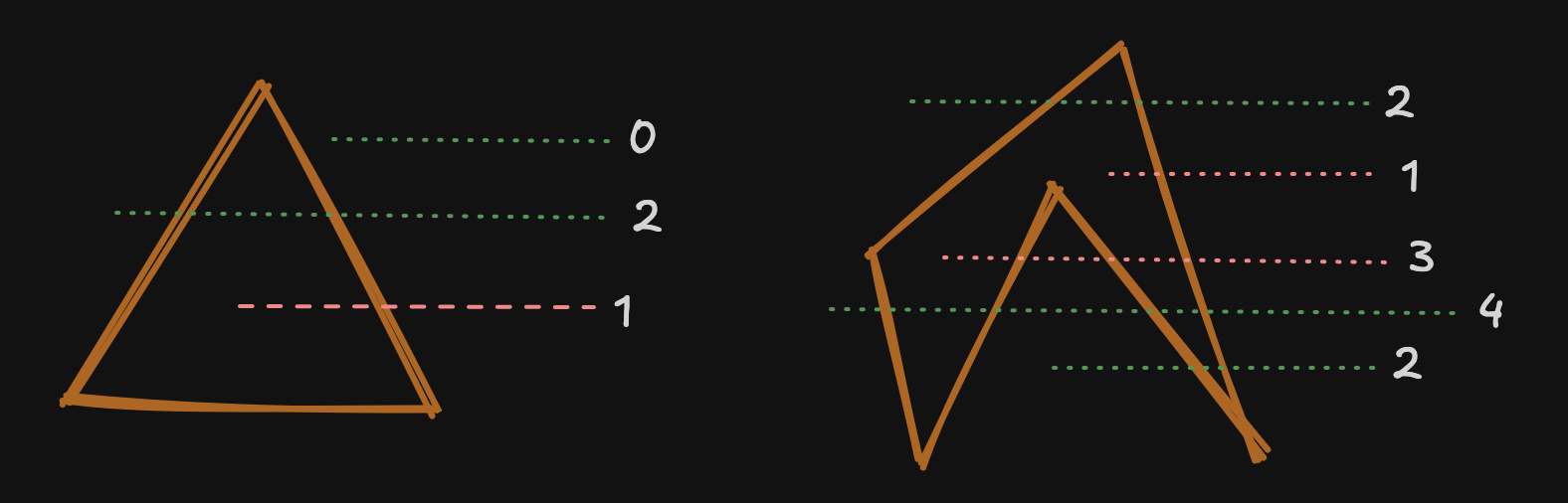
- Convert your point P into a line PQ, where Q is a point far away from P
- for example, Q could be at point \(P + (0, 10e^6)\)
- the important part is that Q must be outside of the polygon.
- For each line that makes up the polygon, determine if that line intersects line PQ (see Line Intersection)
- If the number of intersections is odd, P is inside the polygon, otherwise it is outside the polygon.
Line intersects Polygon
There are two cases to detect:
- The line intersects the polygon’s outer lines
- Line is contained within the polygon
To detect line intersection:
- For each line of the polygon, does that line AB intersect (see Line Intersection)
- If there are no line intersections, check if point A of line AB is in the polygon (see Point in Polygon)
Polygon intersects Polygon
There are two cases to detect here too:
- polygon contained in polygon
- polygon crosses polygon perimeter
If we have polygon A and polygon B:
- For each line in polygon A, check if it intersects polygon B (see Line intersects Polygon)
This handles both cases since we also check if a line is contained in the polygon
Circles
Point in Circle
If we have a circle A and a point P, check that the distance between P and the circle’s center is less or equal to the circle’s radius.
For efficiency, I compare the distance squared instead:
\[r^2 \leq (C_x - P_x)^2 + (C_y - P_y)^2\]Where:
- \(r\) is the circle’s radius
- \(C\) is the center point of the circle
- \(P\) is the point of interest
This saves on computing a square root which can be computationally inefficient.
Line Intersects Circle
Given a line AB and a circle C:
- Find the closest point P on line AB to the circle C’s center point (see Closest Point On Line)
- Check if P is in the circle (see Point in Circle)
Polygon Intersects Circle
If we have polygon A, and circle B:
- For each line of A check if that line intersects the circle (see Line Intersects Circle)
Circle Intersects Circle
If we have circle A and circle B, this is very similar to point in circle, but we sum the radius’s together:
\[(r_A + r_B)^2 \leq (A_x - B_x)^2 + (A_y - B_y)^2\]Where:
- \(r_A\) and \(r_B\) are the radii of circles A and B respectively
- \(A\) is the center point of circle A
- \(B\) is the center point of circle B